Events

1953
09/07/1953

Genova, Circolo della Stampa

Where: Genoa, Circolo della Stampa

Date: 1954

When Novaresio came back from his first trip to Somalia, he brought with him the results of his African artistic research. As critics pointed out, the artist was not interested in ‘easy’ exoticism: on the contrary, he wanted to portray reality with incisive and concise signs. Those displayed here were the works exhibited the same year in Mogadishu.

Images and scans

Illustrazione catalogo mostra

03/07/1953

VII Mostra Regionale d’arte

Where: Genoa, Palazzo dell’Accademia

Date: 1953

Critics welcomed the exhibition because the works displayed here provided a complete overview of the various trends within the Ligurian art. Novaresio won the award for his Natura morta [Still life], although Crocefissione [Crucifixion] received better reviews in newspapers.

01/07/1953

Genova, Galleria San Matteo 1953

Where: Genoa, Galleria San Matteo

Date: 1953

Scafo di piroscafo

The exhibition focused on the ‘birth’ of a ship in the shipyard. Novaresio treated this subject (which was fashionable at the time) without rhetoric: he did not use an evocative or descriptive tone, but his drawings are sharp, schematic and precise, just like a scientific study.

Images and scans

03/01/1953

Genova, Associazione “La Serenissima”

Where: Genoa, Associazione ‘La Serenissima’

Date: 1954

An example of the often abused comparison between art and nature: Novaresio’s and Tampieri’s paintings were displayed in the halls of the association ‘La Serenissima’, together with the works of the flower painter Podestà. No photographs were found, but the theme of the exhibition suggests that the paintings presented here (certainly not Novaresio’s most representative works) were mainly figurative.

Images and scans
Ragazza somala

1952
14/05/1952

Genova, Galleria Rotta 1952

Luogo:
Genova, Galleria Rotta
Anno:
1952

DeposizioneQuesta mostra raccolse generale consenso da parte della critica, che seppe leggere il significato della ricerca di Novaresio all’interno di una selezione decisamente eterogenea. Alle pareti si allineavano infatti sia opere figurative (soggetti sacri e floreali, paesaggi e ritratti) sia astratte: due linguaggi che saranno in costante dialogo nella produzione dell’artista.

1950
18/04/1950

Marsiglia, 1950

Luogo:
Marsiglia
Anno:
1950

Mostra nota da poche citazioni documentarie, ancora oggetto di studio.

1949
10/11/1949

Genova, Caffè Venchi

Where: Genoa, Caffè Venchi

Date: 1949

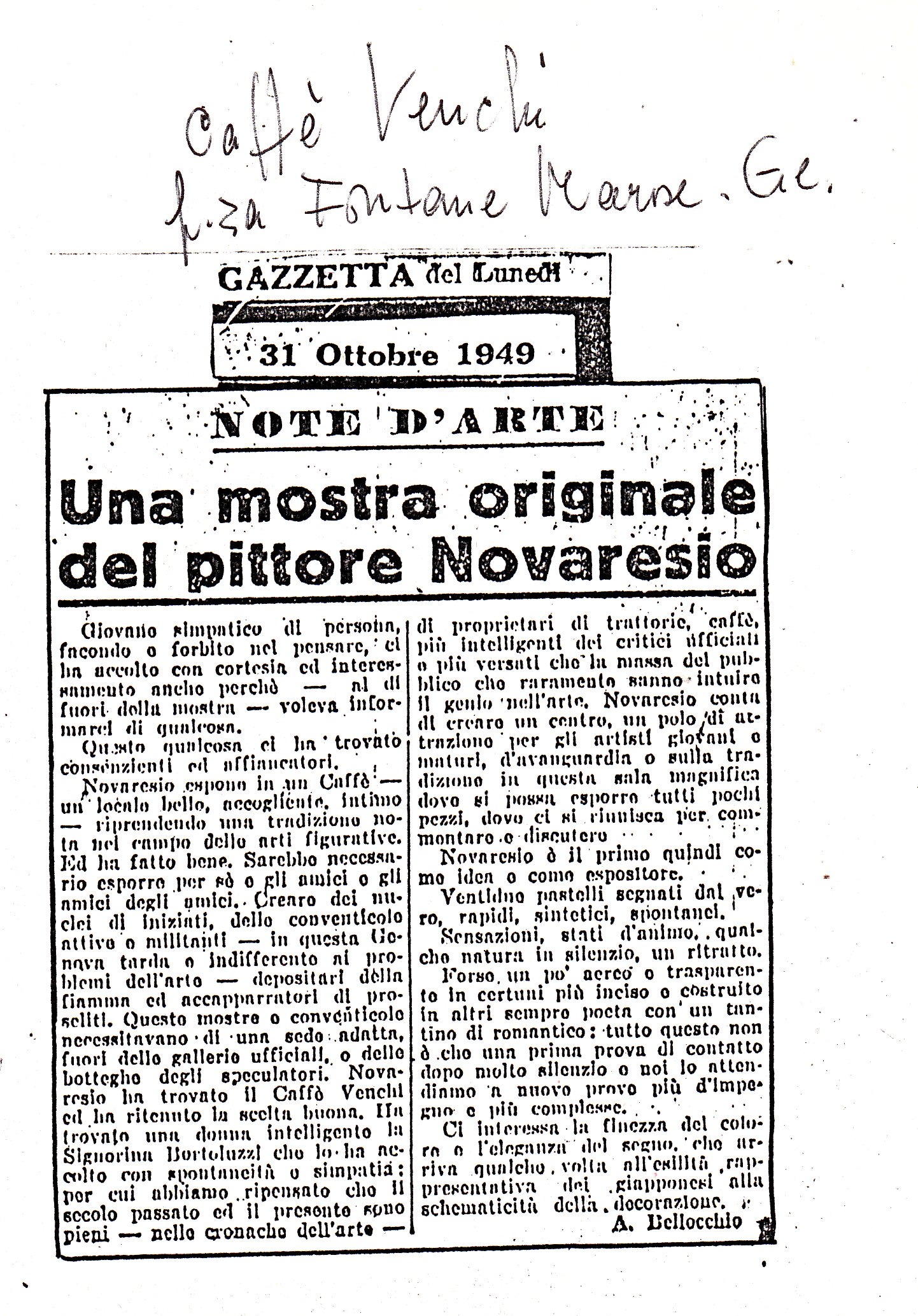
The peculiarity of this exhibition is its venue: a real café, where you could admire paintings while enjoying a drink. This was not the only example of this sort: in the 1940s, any place could indeed become an exhibition venue (furniture factories, barracks, hotels). Here Novaresio tried to establish a new cultural centre, in the wake of L’Isola. Even if they were able to attract other artists (such as Fieschi) and art dealers (Cardazzo), the venue was closed.

Images and scans

Ritratto della signora Anita Martini

1948
26/06/1948

III Mostra regionale d’Arte

Where: Genoa, Galleria Rotta

Date: 1948

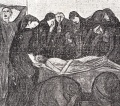
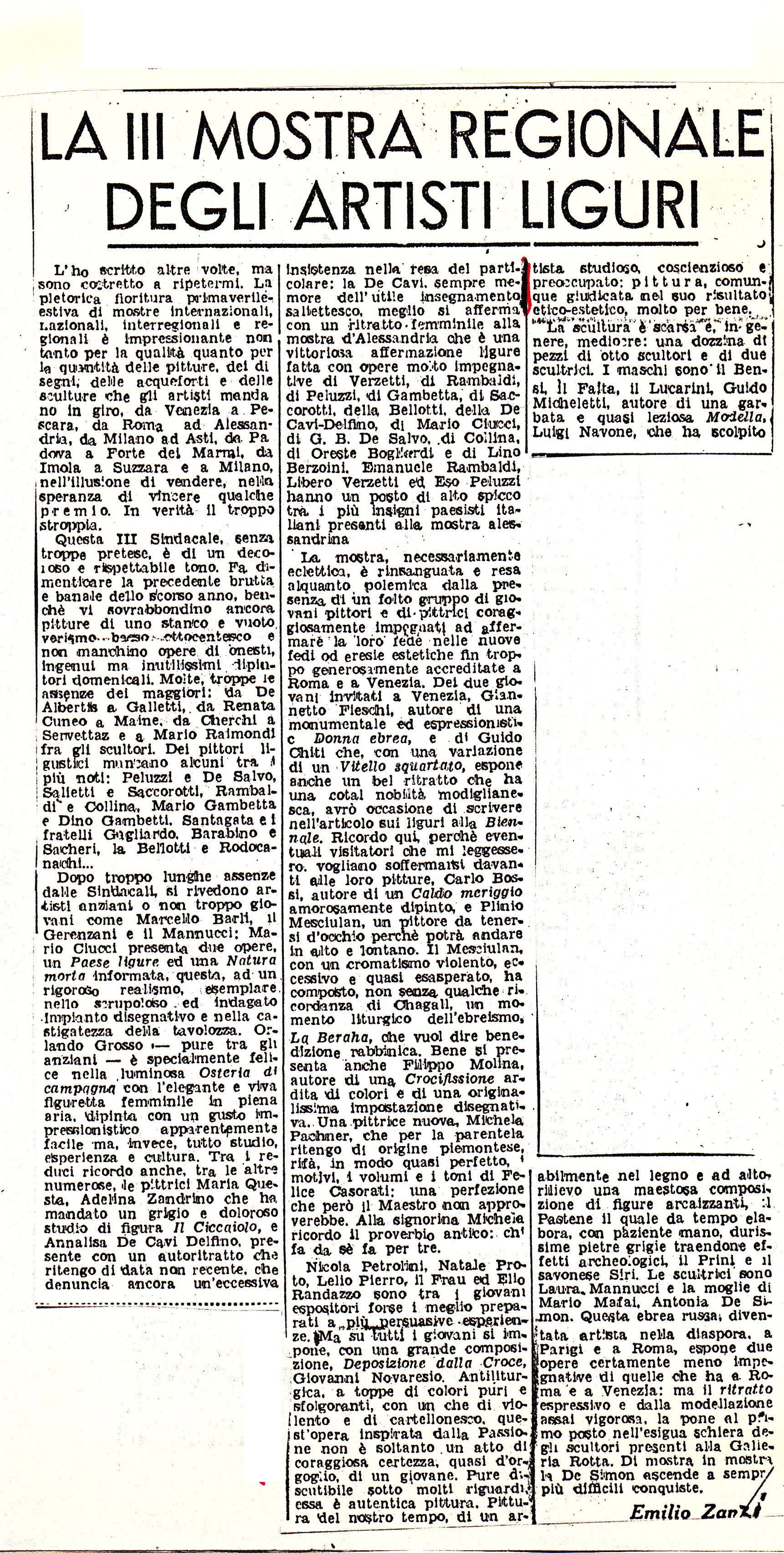
Critics considered Novaresio’s Deposizione dalla Croce [Deposition from the Cross] as one of the most interesting works of the entire exhibition: a painting far from the traditional representation of the evangelical episode, but still dramatic. On this occasion, Novaresio received an important prize.

22/01/1948

Genova, Galleria Genova e l’Isola 1948

Where: Genoa, Galleria Genova e l’Isola

Date: 1948

In this solo exhibition, Novaresio displayed only a series of drawings. Critics, who had always appreciated the artist’s drawing skills, once again pointed out the dialectical relationship between abstract and figurative art.

Images and scans

1947
18/04/1947

Genova, Galleria Genova e l’Isola

Where: Genoa, Galleria Genova e l’Isola

Date: 1947

Last event before the summer break. It included a solo exhibition by Borella and the display of Verzetti’s tempera paintings. A section of the exhibition was dedicated to young Genoese artists (Basso, Bisio, Mesciulam, Novaresio, Petrolini, Fieschi), and another part to the reproductions of works by the most important contemporary artists.

Images and scans

16/04/1947

II Mostra Regionale del Sindacato Belle Arti

Where: Genoa, Galleria Ranzini

Date: 1947

Critics agreed that the exhibition was not entirely successful: among the causes, the absence of many artists, the inaccurate selection of the works and the lack of suitable prizes for the winners. However, many young artists were appreciated, including Novaresio, who displayed the painting Figura seduta [Sitting Figure].

11/02/1947

Mostra di “bianco e nero”

Luogo:
Genova, Galleria Genova e l’Isola
Anno:
1947

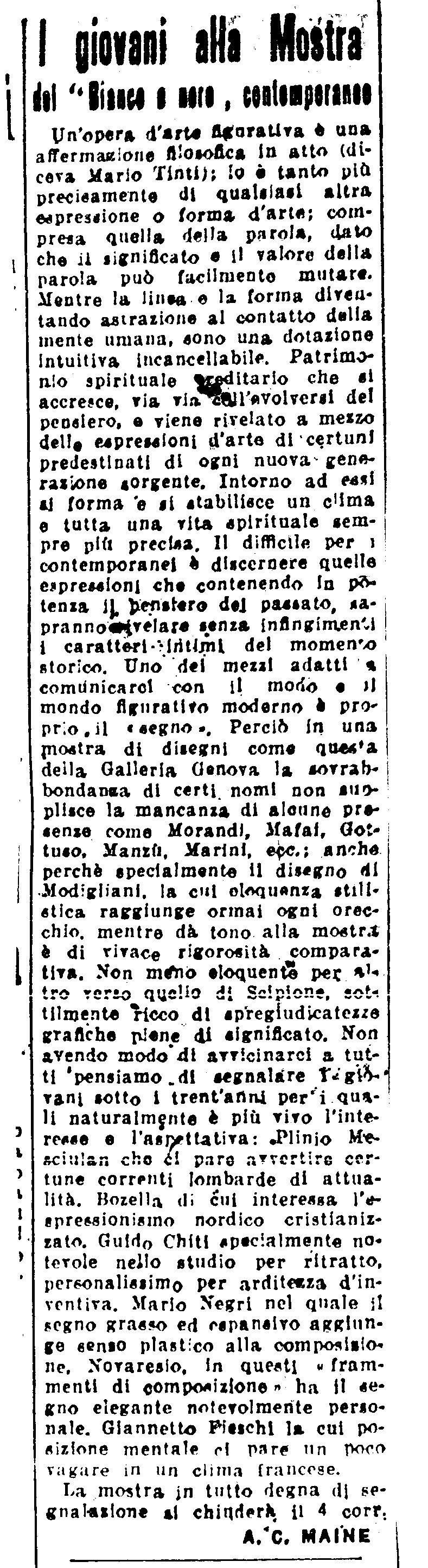
Grandi consensi furono espressi per questa esposizione totalmente dedicata all’arte grafica, non solo per i disegni degli autori più celebri (Modigliani, Scipione) ma anche per le opere presentate dai giovani (Mesciulam, Borella, Fieschi,Novaresio)

1946
04/12/1946

Genova, Galleria Lo Zodiaco

Where: Genoa, Galleria Lo Zodiaco

Date: 1946

A small, short-lived gallery, which tried to focus its activity on the Avant-garde. Casorati, Mesciulam, Fieschi, Scanavino, Basso, Cherchi, Santomaso were among the artists who took part in this exhibition.

Images and scans

16/04/1946

Acquerelli di Giovanni Novaresio

Where: Genoa, Galleria Genova e l’Isola

Date: 1946

Novaresio’s first solo exhibition, for which he received unanimous approval. Critics appreciated these watercolours, especially because of the rapid brush strokes and the careful study of luministic values.

Images and scans
Acquerelli di Giovanni Novaresio

15/04/1946

Prima Mostra Nazionale d’Arte Sociale

Where: Genoa, Palazzo Reale

Date: 1946


The provincial socialist federation organized this event, in order to celebrate the new social myths, such as work. The exhibition, however, was not successful, due to its propaganda purposes and the illustrative style of many paintings.

1945
07/11/1945

Genova, Galleria d’Arte di Piazza Dante (ex Galleria Euro Romano)

Where: Genoa, Galleria d’Arte di Piazza Dante (former Galleria Euro Romano)

Date: 1945

This exhibition marked the closure of the Galleria Romano: although it took place in the same premises, the press simply wrote about an unspecified “Art Gallery”. This was, however, a high-level exhibition, with artists like Carrà, Casorati, Morandi, Mafai, Guttuso.

Images and scans

05/11/1945

Artisti d’oggi

Where: Genoa, Galleria Euro Romano

Date: 1945

The difficulties caused by the war did not stop the activity of Euro Romano. The exhibition shows how this gallery was still trying to display the works of some of the most representative artists of the time, including Birolli, Sassu, Vedova, together with young Genoese artists, such as Novaresio, Verzetti, Cherchi and Fabbri.


Images and scans

03/11/1945

Genova, Galleria Euro Romano

Where: Genoa, Galleria Euro Romano

Date: 1945

Little information was found about this exhibition. Among the participants were Alfieri, Borella, De Pisis, Gargani, Galletti, Novaresio, Rodacanachi, Saccorotti, Salietti, Vedova, Verzetti: another evidence of how the art gallery consistently maintained its focus on Avant-garde.

Images and scans

18/04/1945

XV Mostra Interprovinciale di Belle Arti della Liguria

Where: Genoa, Galleria Euro Romano
Date: 1945
Every year, the inter-provincial exhibition opened amid a series of controversies: the most common were related to the lack of a suitable venue for contemporary art exhibitions in Genoa, and to the criteria for the selection of the jury members. In addition, the 15th exhibition did not receive rave reviews from critics, who also felt lukewarm about Novaresio.

Images and scans

1944
05/11/1944

XIV Mostra Interprovinciale di Belle Arti della Liguria

XIV Mostra Interprovinciale di Belle Arti della Liguria, Genoa, Galleria Euro Romano, 1944
Where: Genoa, Galleria Euro Romano
Date: 1944
It is still impressive to see that, despite the war, artists perseveringly continued to exhibit in Genoa. The 14th inter-provincial exhibition is an emblematic case of this situation. On that occasion Attilio Podestà, the most influential critic of those years, noticed the young Novaresio.